 Breaking News


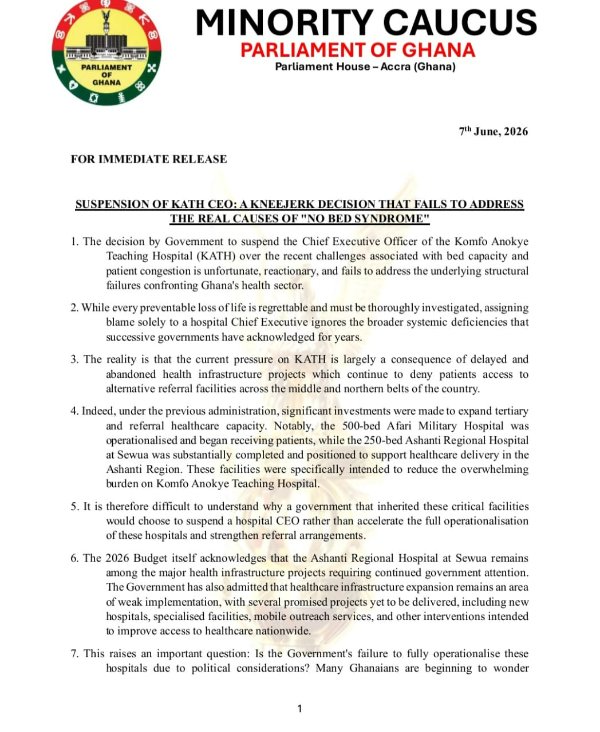
The Minority Caucus in Parliament has called for the immediate reinstatement of the suspended Chief Executive Officer of Komfo Anokye Teaching Hospital (KATH), arguing that Ghana's recurring "No Bed Syndrome" is the result of systemic healthcare failures rather than poor leadership at the facility.
The caucus described the suspension as a misplaced response to challenges facing the country's second-largest referral hospital, insisting that unresolved infrastructure deficits, delayed hospital projects and referral system bottlenecks are the real drivers of congestion at KATH.
The statement, signed by Dr. Nana Ayew Afriye, Ranking Member on Parliament's Health Committee, acknowledged the need for investigations into recent incidents linked to overcrowding and bed shortages at the hospital. However, it maintained that holding the hospital's management solely responsible ignores broader challenges confronting Ghana's healthcare sector.
According to the Minority, KATH continues to face overwhelming pressure because several health facilities expected to reduce patient inflows have either not become fully operational or remain underutilised.
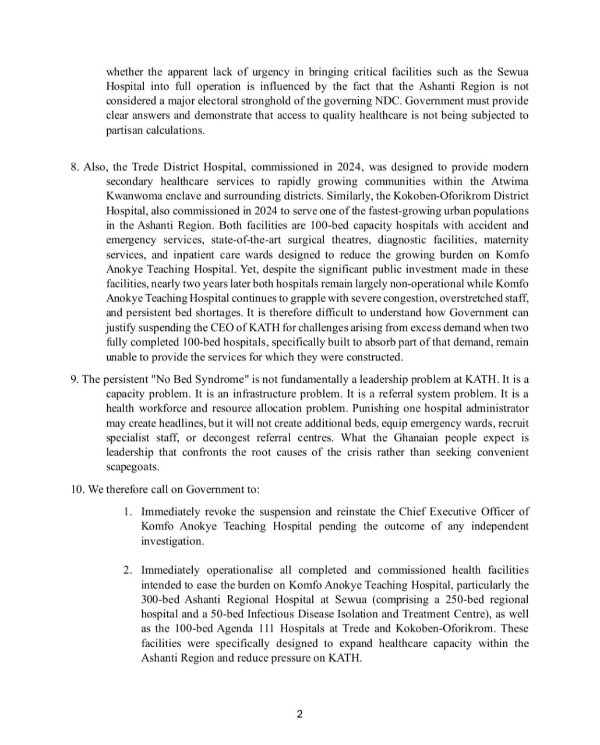
The caucus cited the Ashanti Regional Hospital at Sewua, the Afari Military Hospital, and the Agenda 111 district hospitals at Trede and Kokoben-Oforikrom as major projects intended to ease the burden on KATH.
It argued that despite significant public investment in these facilities, delays in their full operationalisation have left KATH overstretched and struggling to accommodate increasing patient numbers.
"The persistent 'No Bed Syndrome' is not fundamentally a leadership problem at KATH. It is a capacity problem. It is an infrastructure problem. It is a referral system problem," the statement stressed.
The Minority questioned the rationale behind suspending the KATH CEO instead of prioritising the completion and operationalisation of healthcare facilities designed to expand service capacity in the Ashanti Region and beyond.
It also pointed to the 2026 Budget, which identified the Sewua Hospital among major health infrastructure projects requiring further government attention.
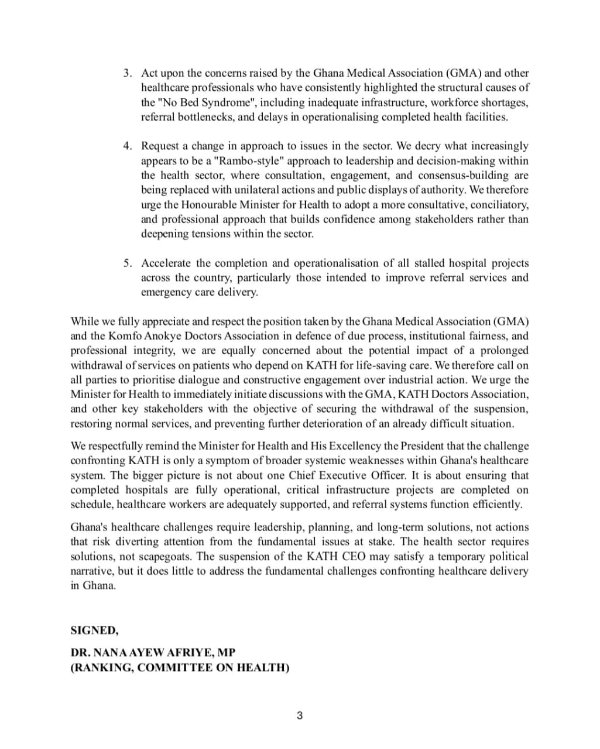
Beyond infrastructure concerns, the caucus called on the government to address long-standing issues raised by healthcare professionals, including staffing shortages, inadequate medical infrastructure and weaknesses in the national referral network.
As part of its recommendations, the Minority urged government to revoke the suspension pending the outcome of any independent investigation, accelerate the operationalisation of completed hospitals and fast-track stalled healthcare projects nationwide.
The caucus further appealed to the Minister for Health to adopt a more consultative approach in handling challenges within the sector to avoid escalating tensions among key stakeholders.
While expressing support for concerns raised by the Ghana Medical Association and the Komfo Anokye Doctors Association over due process and institutional fairness, the Minority encouraged all parties to pursue dialogue and avoid actions that could disrupt healthcare delivery.
"The health sector requires solutions, not scapegoats," the statement concluded, calling for long-term investment in healthcare infrastructure, stronger referral systems and sustainable reforms to address the country's recurring bed shortages.











Comments (0)
No comments yet. Be the first to comment!