 Breaking News

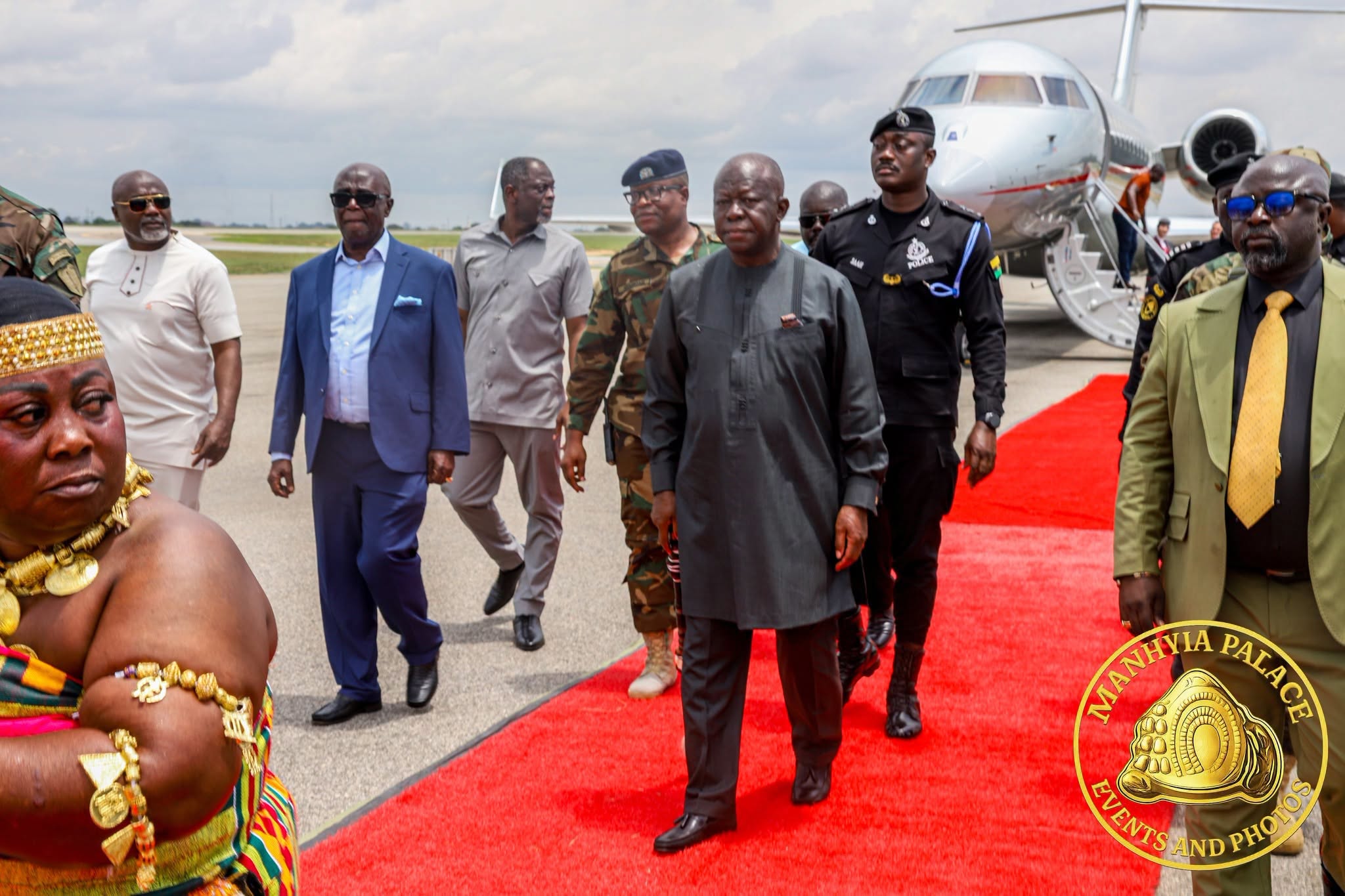
There is a particular way the light falls over the Ashanti hills in the late afternoon: gold first, then amber, then a deep bronze that seems to set the rooftops of Kumasi on fire, as if the sun itself had dressed for the occasion. It was into this light that the aircraft carrying His Majesty Otumfuo Osei Tutu II began its slow, graceful descent toward home.
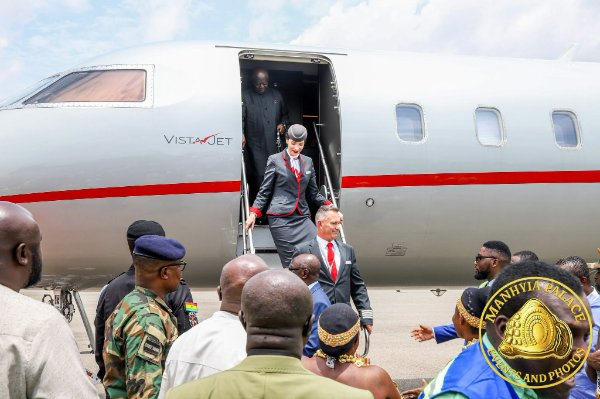
Out of the Clouds, Into the Ashanti Hills
From the air, Kumasi does not simply appear; it unveils itself, one green ridge at a time. The forest presses close on every side, reluctant; it seems, to let the city go. Cocoa farms stitch the land in soft, uneven squares. The roads wind through the hills like veins carrying something alive. It is easy, looking down; to understand why they call this place the Garden City; even from a mile up, Kumasi breathes green.
The aircraft banked low over this quilted landscape, and then straightened, and the runway rose to meet it, the long, freshly extended strip of Prempeh I International Airport, a gateway that has watched over Kumasi's comings and goings since it first opened its arms to flight. The airport sits only a short drive from the city's beating heart, close enough that a visitor can step off the tarmac and feel the city's pulse within minutes. Fittingly, the airport now bears the name of Prempeh I, the great Asante King who once carried this very stool through exile and back into glory, a name suspended overhead as its present custodian touched down on the soil that made him.
The wheels kissed the tarmac with a soft, certain thud, and something in the airport itself seemed to exhale. Ground crews who had watched the sky for the better part of an hour broke into applause before the aircraft had fully stopped. Somewhere beyond the perimeter fence, the first drums were already answering as if the earth itself had been waiting for that sound to begin.
A City Waiting to Erupt
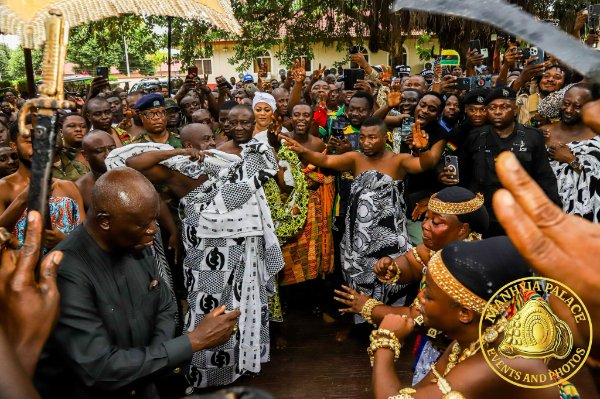
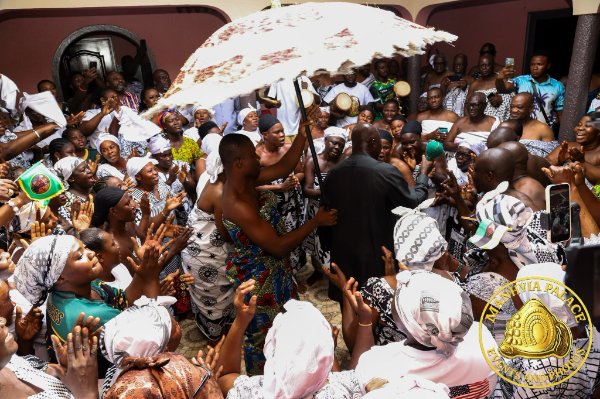
No pen, and certainly no camera, could hold what waited beyond those gates. They had been arriving since morning on foot, packed into trotros, riding the open beds of pickup trucks from all walks of life. By the time the King's convoy eased through the gates, the crowd had swelled into something closer to an ocean: a shifting tide of kente and adinkra cloth, of children lifted onto shoulders for a better view, of grandmothers who had stood since dawn and would not be moved by sun, thirst, or time.
Then came the sound not one sound, but many, colliding into a single wave. Traditional drums and the long, curved ivory trumpets of the Asante court cried out in phrases reserved only for royalty, phrases older than most of the buildings around them. Women broke into the high, trembling ululation that every Ghanaian recognizes as the sound of something sacred unfolding. Beneath it all rolled the crowd's own voice, chanting, praising, calling out "Nana!" again and again, until the word itself became a kind of drumbeat.
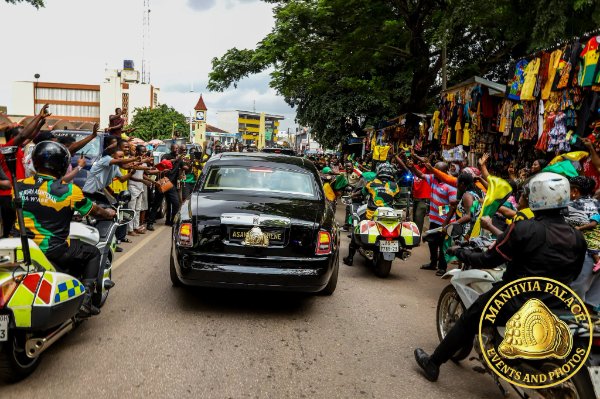
The convoy did not hurry. It could not. The King's car, moved at the unhurried pace of a procession rather than a motorcade; because a King does not rush past his people. He receives them. Cloths were waved overhead like flags of a nation within a nation. Men in full traditional regalia danced beside the moving vehicles, undeterred by heat or crowd, because this was not mere traffic. It was liturgy in motion.
Through the Streets of the Garden City
The principal streets of Kumasi had transformed into something between a parade ground and a shrine. Vendors abandoned their stalls, not for lack of customers but because there was, for once, something far more important to witness. Balconies sagged gently under the weight of onlookers. Even the traffic lights seemed, for one afternoon, to defer to the occasion.
The scenery itself appeared to conspire in the moment. Kumasi's flame trees and frangipani lined stretches of the route, their blossoms catching the same late light that had greeted the aircraft an hour earlier, so that petals occasionally drifted down onto the convoy like a blessing no one had ordered but everyone understood.
By the final stretch, exhaustion and joy had become indistinguishable. Strangers embraced. Old men wept without shame. Somewhere, a brass band that no one remembered inviting simply began to play, and no one thought to ask them to stop.
Home to Manhyia
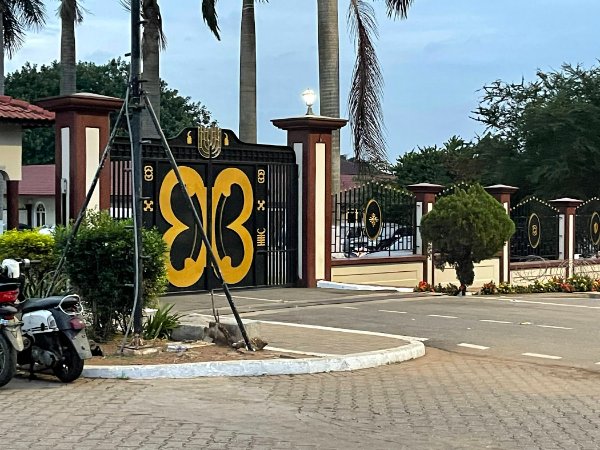
At last, the gates of Manhyia Palace rose into view, and if the streets had been a river of noise and color, the palace grounds were where that river finally met the sea. The ceremonial trees lining the palace approach, long dressed in swaths of black, gold, and green cloth for the occasion, stood like patient sentries who had also been counting the hours. The palace gate itself, unhurried and ornate in its old architecture, seemed to widen as the King drew near, the drums softening now into something quieter, and more intimate.
Inside those walls, before any other business of state, tradition called him first to his mother. As custom demands of every Asantehene returning from a journey, Otumfuo Osei Tutu II went to show himself to the Queen Mother; a quiet, almost hidden gesture, largely unseen by the thousands still celebrating beyond the gates, yet no less central to the day than the drums or the dancing. It is easy to miss amid the roar of a royal welcome, and yet it is the hinge on which everything else turns: a King's authority in Asanteman flows always through the Queen Mother's blessing, and no homecoming is truly complete until that circle closes.
Across the Atlantic: A Lecture at Howard
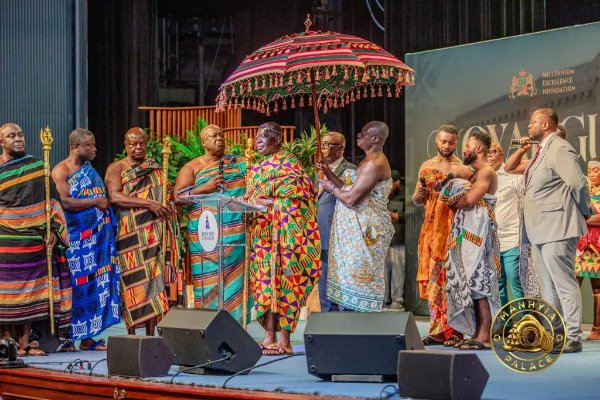
The King's journey home came at the tail end of a demanding stretch abroad; one that had carried him across the Atlantic for a historic visit to the United States. Its centerpiece was his first royal lecture at Howard University in Washington, D.C., delivered inside Cramton Auditorium to a hall packed with students, scholars, and members of the Ghanaian diaspora.
The setting itself carried its own weight of history. Founded in 1867, in the fragile, hopeful years just after slavery's end, Howard rose in the nation's capital as one of America's first historically Black universities; a place built, quite literally, so that a people once denied learning could claim it in full. Its campus, known simply as "The Yard," sits in Washington, D.C., not far from the halls of American power and yet a world unto itself: red-brick buildings, wide lawns, and more than a century and a half of graduates who went on to reshape law, medicine, literature, and the struggle for civil rights. It is a campus that has long understood itself as a bridge between Africa and its diaspora, between the past and what comes next.
It was into this setting, freighted with its own long memory of dispersal and return that an Asante King walked to speak of unity. He reflected on the bonds joining African peoples across the globe, on the quiet work of preserving cultural heritage in a fast-forgetting world, and on the enduring, unbroken thread tying the continent to the millions of its children scattered far from home. It was, by every account, a message that reached well past the auditorium's walls; clips of the address travelled quickly online, carried by a diaspora hungry for exactly the kind of steady, grounding wisdom their King had come to offer.
That same message seemed to travel home with him. As his convoy rolled through Kumasi's jubilant streets days later, it was hard not to feel the echo of Howard's Yard in the crowd's own chants; a King who had spent his weeks abroad reminding scattered children where they came from, now returning to the very soil that message was rooted in, welcomed by a city that had never once doubted where his heart belonged.
By nightfall, the drums fell silent, the petals settled, and the flame trees stood still once more. But for one golden afternoon, Kumasi remembered what it holds: a King whose wisdom is its citadel, and whose homecoming is its proof.
By Kwaku Amoh-Darteh, Esq.












Comments (0)
No comments yet. Be the first to comment!