 Breaking News

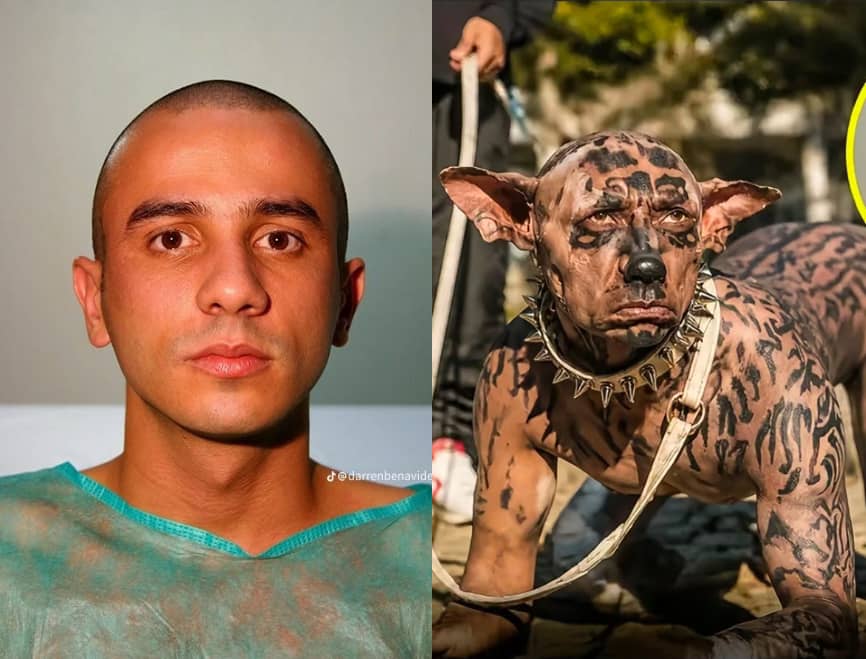
A man becoming a dog sounds like the kind of story designed to dominate social media. It is unusual, shocking and almost too strange to believe. Recently, claims circulated online that a 26‑year‑old Japanese millionaire had spent $2.7 million to transform himself into a dog.
The story quickly attracted attention, with photographs appearing to show a human being with the appearance of a real dog.
For many people, the images seemed to provide enough evidence to believe the claim. But this is exactly where we need to be careful.
The documented story is quite different.
The Japanese man known online as Toco became famous for fulfilling a childhood desire to experience life as a dog. Rather than undergoing surgery, he reportedly spent about 2 million Japanese yen on an extremely realistic collie costume created by Japanese company Zeppet.
Reports said the costume took about 40 days to make and was carefully designed to resemble a real dog.
The difference between the verified story and the viral claim is enormous. Two million yen is nowhere near $2.7 million, and wearing a costume is very different from surgically transforming the human body.
For me, the most important issue raised by this story is not whether someone should want to dress like a dog. People have different interests, dreams and forms of self‑expression. What deserves greater attention is how quickly an unusual story can be distorted once it enters the social‑media environment.
Today, being first often appears to matter more than being accurate. A sensational headline can attract thousands of views before anyone stops to ask whether the information is true. Once a claim is repeated enough times, people may begin to treat it as fact simply because they have seen it everywhere.
This presents a serious challenge for journalism.
Journalists have a responsibility to verify information before publishing it, particularly when dealing with extraordinary claims. A photograph alone is not enough to establish the circumstances surrounding it. Neither is a viral post, a social‑media caption nor the number of people who have shared it.
The responsibility also extends to social‑media users. We have all become potential distributors of information. With one click, we can pass an unverified claim to hundreds or even thousands of people. That makes media literacy more important than ever.
The Toco story demonstrates why people should look beyond the headline. The images may be real, but the story attached to them may not necessarily be accurate. This distinction is important because misinformation does not always begin with a completely fabricated event. Sometimes it begins with a real event that is exaggerated, misinterpreted or stripped of its original context.
There is also a lesson here for journalists and media organisations competing for audience attention. The pressure to produce content that attracts clicks should never replace basic journalistic principles. Accuracy should remain more important than virality.
A misleading story may generate traffic today, but it can damage public trust tomorrow. Once audiences repeatedly encounter inaccurate information from media platforms, they may begin to question even stories that are properly researched and verified.
The unusual story of a Japanese man who invested heavily in a realistic dog costume may be entertaining to some and difficult for others to understand. But regardless of our personal reactions, his story should not become an excuse to abandon journalistic standards.
In an age where information travels faster than ever, perhaps the most valuable habit we can develop is also the simplest: pause before believing and verify before sharing.
The real story may not always be as dramatic as the viral version.
But journalism is not about telling the most dramatic story. It is about telling the most accurate story.
And sometimes the truth does not need exaggeration to be interesting.
By: Mariam Tuferu Tunteya a student of Journalism and Media Studies at the University of Education, Winneba (UEW).












Comments (0)
No comments yet. Be the first to comment!