 Breaking News

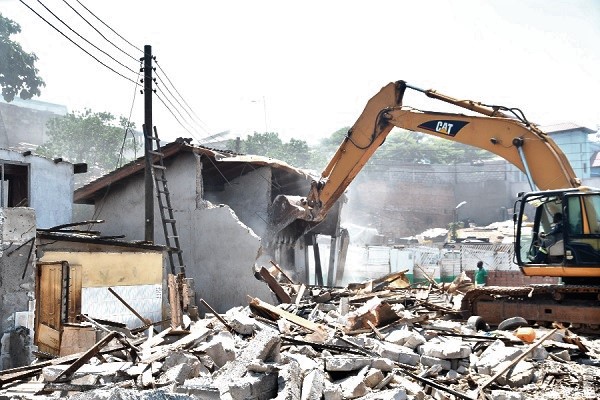
Walking through an Accra neighbourhood one morning, residents found notices ordering them to vacate: their area was scheduled for demolition. For many, this sudden command was not imagination but reality.
Signs such as “Remove by District Assembly” or “Stop Work and Provide Permit” have long appeared on buildings across Ghanaian communities. In numerous instances those warnings are painted over and construction continues.
The crucial question is whether those property owners later obtained the required permits from the district assemblies, or whether they ignored directives and pressed on regardless.
However, many people served with demolition notices refuse to comply.
They complete buildings, open businesses or rent properties to tenants. Years later, when those structures are demolished, responsibility is disputed: should blame fall on the government, the property owners, or the vendors who sold the land?
Recent demolitions in Accra form part of government efforts to remove structures obstructing waterways, improve drainage and prevent a repetition of the devastating floods of June 29, 2026 that affected Mallam, Awoshie, Kaneshie, Circle and Achimota.
The operation has provoked mixed reactions.
Supporters argue the government’s actions are necessary: the disregard of planning rules by a few places entire communities at risk during heavy rains.
Critics contend district assemblies are acting unfairly, destroying years of hard work and lifetime investments without adequate consideration of the human consequences.
The emotional toll is palpable. In a social-media post a distraught resident said: “I will not move away. They should rather kill me. My children’s school uniforms, books and everything we own are in that house. What do you want me to do?
It is better you kill me.” A woman whose property is at Old Barrier asked why structures allegedly authorised in the past are now being treated as illegal.
“They should come and explain to us because they were the same people who gave us the permit, which means we have the right to be here. So why are they now demolishing our structures?” she said.
The controversy exposes complex failures in land administration, permitting and enforcement.
Evelyn Korkor, a real-estate developer, argues the problem extends beyond property owners.
“When you look at Accra, much of the land belongs to chiefs and indigenous families,” she said. “They know the history and nature of the land better than anyone else.
"If flood-prone land becomes attractive again after the rains, will it simply be sold to another group of people who may face the same destruction in the future? Land sellers must also be held accountable for their actions.”
Experts and residents are calling for stronger, more transparent systems. District assemblies should do more than issue permits, collect fees and later supervise demolitions: they must strengthen monitoring and enforcement to prevent illegal developments becoming homes and businesses in the first place.
Policymakers also have a responsibility to protect citizens who have entrusted them with public office.
Preventing future floods is essential, but ensuring accountability, fairness and transparency throughout the process is equally important.
Clearer record-keeping of permits, publicly accessible land and permit registries, and rigorous action against those who sell or re-sell flood-prone land without disclosure are among the measures suggested by stakeholders.
Without systemic reforms, demolitions risk punishing vulnerable residents while failing to address the root causes of hazardous development.
By: Nancy Mamle Lawer, a Journalism and Media Studies student at the University of Education, Winneba (UEW).








Comments (0)
No comments yet. Be the first to comment!