 Breaking News

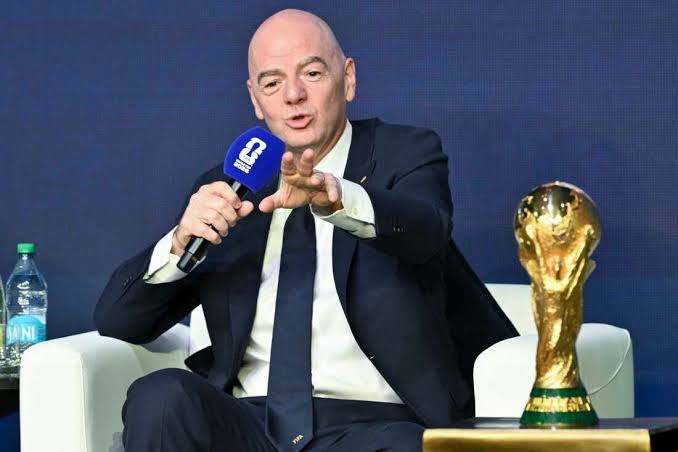
The Union of European Football Associations (UEFA) announced on Thursday, July 30, that it will boycott future men’s and women’s World Cups in response to FIFA President Gianni Infantino’s plan to permit private investment in its competitions.
In a statement issued following an emergency meeting of its 55 member associations, UEFA said it "unanimously and unequivocally" rejected FIFA’s proposal to create a new World Cup spin-off.
UEFA said the plan envisages selling up to 20% stakes to external investors, including Joshua Kushner, whose brother Jared is US President Donald Trump’s son-in-law.
It argued that the World Cup must not be treated as an investment product.
"Without Europe's participation, Infantino's venture would become far less attractive, both competitively and commercially as Europeans dominate the competition. Three of the four teams to reach the semi-finals were European: France, England and winner Spain," the statement said.
During the meeting, delegates from more than 40 national associations spoke out to condemn the proposal as unacceptable, with all of them agreeing to the boycott, sources familiar with the discussion told Euronews.
"National associations around the world are now presented with an ultimatum: accept the irreversible capture of football's greatest competitions or bear the consequences," the statement said.
UEFA added that no national side from its member associations will participate in any FIFA competition "for so long as these proposals remain alive", unless FIFA withdraws the plan completely and provides legally binding assurances that it will never again open its governance or competitions to private ownership.
The confederation also confirmed that the next men’s World Cup will be hosted by Spain, Portugal and Morocco in 2030, while the next women’s World Cup will take place in Brazil in 2027.
UEFA warned that, under Infantino’s proposal, commercial influence from investors would affect sporting decisions, resulting in an unprecedented shift in the world of football.
"Football’s future cannot be dictated by the expectations of those whose first duty is to maximise financial return," the statement reads.
EU Commissioner for Sport Glenn Micallef welcomed UEFA’s stance on social media following the announcement: "Proud to see Europe’s football associations leading on governance, standing firm on their principles and defending the integrity of the game."
Infantino’s proposal still faces procedural hurdles
In theory, Infantino’s plan could still be approved despite European opposition. The proposal requires the support of a majority of FIFA members and approval from the FIFA Council, the governing body's 37-member decision-making panel chaired by the president.
FIFA’s voting structure gives each national association one vote, irrespective of size, wealth or footballing history. That means European associations could be outvoted if other confederations back the proposal.
Nevertheless, a coordinated European withdrawal from the World Cup would have significant consequences for players, broadcasters and sponsors, rendering the tournament far less attractive to global audiences.
UEFA is FIFA’s most powerful confederation politically and financially, and its 55 member associations represent more than a quarter of FIFA’s 211 members.
European national teams are among FIFA’s most valuable assets, having won 13 of the 23 men’s World Cups and four of the nine women’s World Cups to date.
The Confederation of North, Central America and Caribbean Association Football (CONCACAF) is holding an emergency meeting on Thursday evening and may follow UEFA’s example.







Comments (0)
No comments yet. Be the first to comment!