 Breaking News

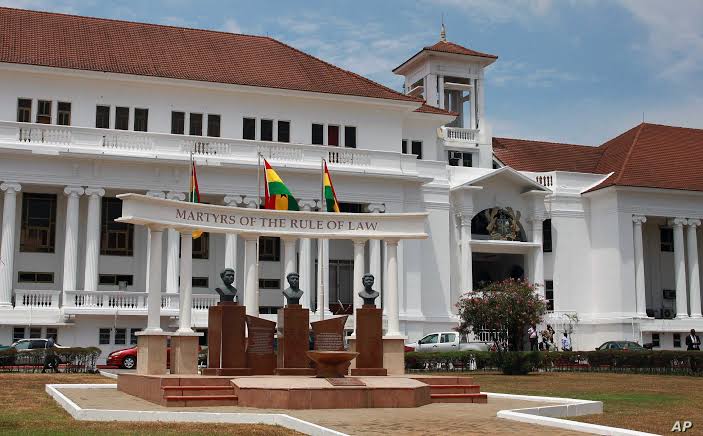
In a landmark ruling that is expected to reshape Ghana’s internal party democracy, the Supreme Court has declared the delegates system used by political parties to elect their presidential and parliamentary candidates unconstitutional.
In a 5–2 majority decision delivered on Wednesday, July 29, 2026, the apex court ruled that all registered, card-bearing members of political parties must be allowed to vote in presidential and parliamentary primaries, effectively ending the long-standing delegates-based electoral system.
The decision follows a constitutional suit filed by former Minister for Environment, Science, Technology and Innovation Prof. Kwabena Frimpong-Boateng; veteran politician Dr Nyaho Nyaho-Tamakloe; and former Minister of Education Dr Christine Amoako-Nuamah.
The three plaintiffs sued the New Patriotic Party (NPP), the National Democratic Congress (NDC), the Convention People’s Party (CPP), the Electoral Commission and the Attorney‑General, arguing that limiting participation in internal party elections to selected delegates violates the democratic principles enshrined in Ghana’s 1992 Constitution.
The plaintiffs contended that Article 55(5) of the Constitution requires political parties to organise themselves in accordance with democratic principles, insisting that restricting the choice of presidential and parliamentary candidates to a relatively small electoral college disenfranchises ordinary party members and undermines internal democracy.
The Supreme Court, by a majority of five justices to two, upheld that argument, ruling that political parties can no longer rely on the delegates system for the election of their parliamentary and presidential candidates. Instead, every duly registered, card-bearing member of a political party must be given the opportunity to vote in such primaries.
Ahead of the ruling, leading NPP member Dr Arthur Kobina Kennedy described the case as an opportunity for the Supreme Court to strengthen Ghana’s democracy, arguing that internal party structures should reflect the constitutional requirement for democratic governance.
He maintained that greater participation by party members would enhance transparency, accountability and public confidence in Ghana’s political system.
The full written judgment of the Supreme Court is expected to provide detailed constitutional reasoning and guidance on how political parties are to implement the decision in future internal elections.
The ruling is likely to have far-reaching implications for the NPP, NDC, CPP and other political parties as they prepare for future presidential and parliamentary contests, marking a significant shift from the delegates-based model that has defined internal party elections for decades.









Comments (0)
No comments yet. Be the first to comment!