 Breaking News


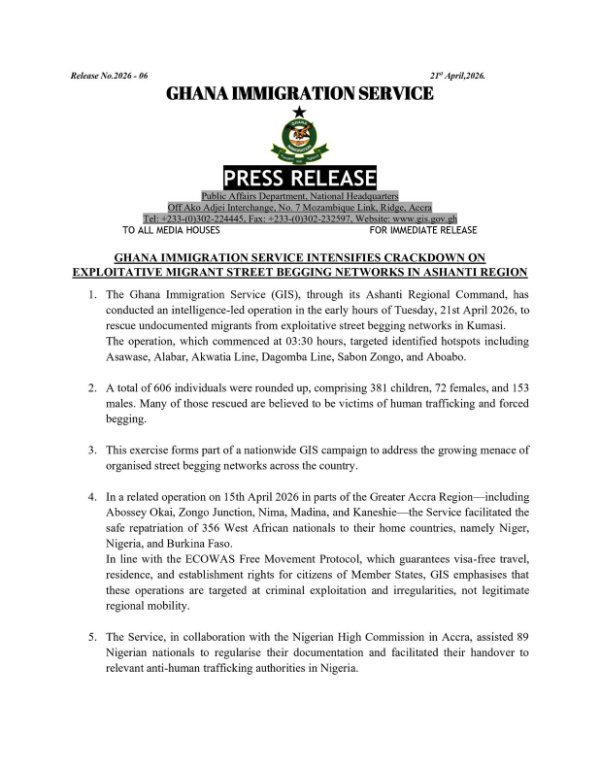
The Ghana Immigration Service (GIS) has intensified its crackdown on exploitative migrant street-begging networks in the Ashanti Region, following a major intelligence-led operation conducted in Kumasi.
According to a press release issued on 21 April 2026, the operation, led by the Ashanti Regional Command, targeted key hotspots including Asawase, Aboabo, Alabar, Akwatia Line, Dagomba Line, and Sabon Zongo.
The exercise, which began in the early hours of Tuesday, April 21, 2026, resulted in the rescue of 606 individuals, comprising 381 children, 72 females, and 153 males. Many of those rescued are believed to be victims of human trafficking and forced street-begging.
This exercise forms part of a nationwide GIS campaign to address the growing menace of organised street-begging networks across the country.
In a related operation on April 15, 2026 in parts of the Greater Accra Region, including Abossey Okai, Zongo Junction, Nima, Madina, and Kaneshiethe, the Service facilitated the safe repatriation of 356 West African nationals to their home countries: Niger, Nigeria, and Burkina Faso.
In line with the Economic Community of West African States (ECOWAS) Free Movement Protocol, which guarantees visa-free travel, residence, and establishment rights for citizens of Member States, GIS emphasises that these operations are targeted at criminal exploitation and irregularities, not legitimate regional mobility.
The Service, in collaboration with the Nigerian High Commission in Accra, assisted 89 Nigerian nationals to regularise their documentation and facilitated their handover to relevant anti-human-trafficking authorities in Nigeria.
GIS has also engaged various African diplomatic missions in Accra to ensure coordinated and humane interventions, particularly for the protection of vulnerable children and destitute persons.
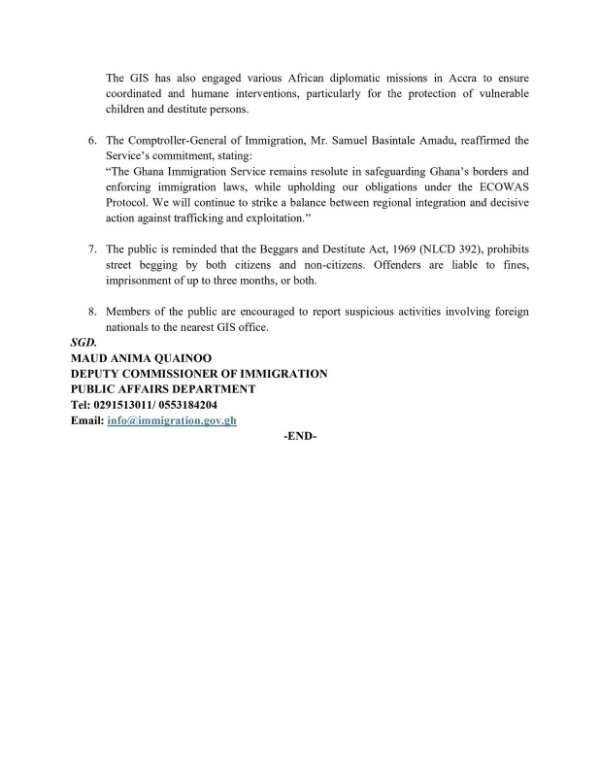
The Comptroller-General of Immigration, Mr. Samuel Basintale Amadu, reaffirmed the Service’s commitment, stating,
"The Ghana Immigration Service remains resolute in safeguarding Ghana's borders and enforcing immigration laws, while upholding our obligations under the ECOWAS Protocol.
"We will continue to strike a balance between regional integration and decisive action against trafficking and exploitation."
It further warned that the Beggars and Destitute Act, 1969 (NLCD 392), prohibits street begging by both citizens and non-citizens, stating that offenders are liable to fines, imprisonment of up to three months, or both.
In addition, the statement encouraged the public to report suspicious activities involving foreign nationals to the nearest GIS office.











Comments (0)
No comments yet. Be the first to comment!