 Breaking News

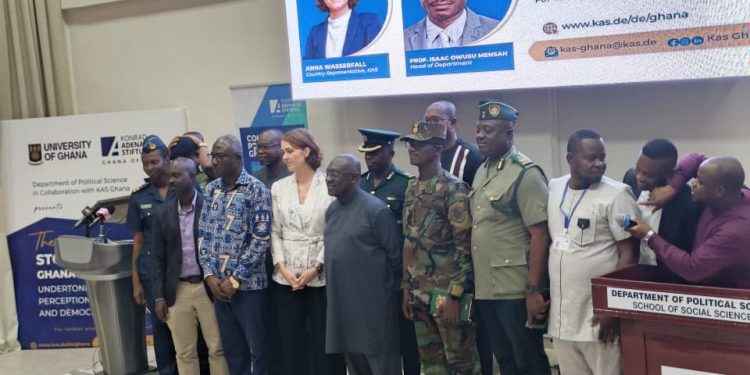
A new study by the University of Ghana’s Department of Political Science has found that 43% of Ghanaians believe military takeovers are sometimes justified, particularly in situations where democratic governance is seen as underperforming.
The report, titled Undertones and Public Perceptions of Military Rule and Democracy in Ghana, surveyed 6,719 respondents across all 16 regions of the country and highlights growing frustrations tied to governance, corruption, and economic performance.
According to the findings, support for the idea of military intervention is strongest in the northern parts of the country, including the Savannah, Upper West, Upper East, Northern, and North East regions.
The Eastern Region also recorded a notable result, with 77% of respondents indicating that military rule could be justified under certain conditions.
The study further revealed that 34% of respondents would support military rule if democracy fails to deliver economic improvements, while 28% said they would support it in cases where democracy fails to effectively address corruption.
Despite these figures, the report emphasized that a majority of Ghanaians still prefer democratic governance over military rule, even with its shortcomings.
Speaking at the presentation of the report on Wednesday, June 9, Head of the Political Science Department at the University of Ghana, Prof. Isaac Owusu Mensah, said the findings reflect both dissatisfaction and resilience in public attitudes toward democracy.
He noted that while citizens expressed frustration over corruption and weak economic outcomes, they still value democratic systems for protecting fundamental freedoms and ensuring accountability.
“The position of the respondents is that even though democracy has a lot of shortcomings… they still prefer democratic governments to military regimes because the military regimes curtail their fundamental human rights and also their ability to change and hold governments accountable,” he explained.
Prof. Owusu Mensah added that many respondents are dissatisfied with democracy not because they reject it, but because they expect better governance outcomes, particularly in relation to corruption and economic performance.
The report recommends stronger transparency mechanisms, improved accountability systems, and more responsive governance to address citizens’ concerns and strengthen democratic trust.








Comments (0)
No comments yet. Be the first to comment!