 Breaking News

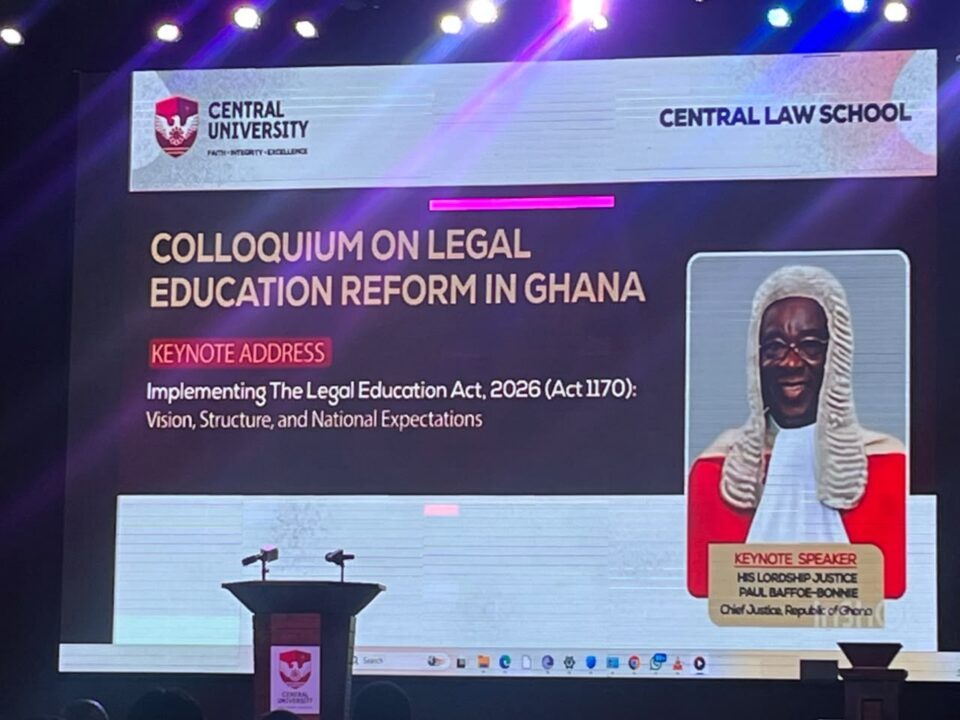
The Chief Justice, Paul Baffoe-Bonnie, has called for the careful implementation of Ghana's new legal education reforms, stressing that widening access to professional legal training must not come at the expense of quality.
Speaking at a colloquium organised by the Central Law School in Accra on the theme, “Implementing the Legal Education Act, 2026 (Act 1170): Institutional Readiness, Accreditation and the Future of Legal Training,” Justice Baffoe-Bonnie described the Legal Education Act, 2026 (Act 1170), as a landmark reform that could fundamentally reshape legal education in Ghana.
According to him, the legislation establishes a more decentralised but well-regulated legal education system, allowing accredited institutions to provide legal training under clearly defined national standards.
"There was a constitutional call for greater fairness, accountability and equal opportunity," he said, noting that the reforms seek to address longstanding barriers that prevented many qualified law graduates from accessing professional legal education.
"For far too long, institutional limitations have frustrated thousands of qualified lawyers. This Act democratises opportunity," he stated.
The Chief Justice, however, warned that broadening access must be matched by rigorous quality assurance measures.
"Access must never mean lowered standards," he stressed.
He noted that lawyers occupy a unique position in society as officers of the courts, defenders of constitutional governance and custodians of the rule of law, making the maintenance of high professional standards non-negotiable.
Justice Baffoe-Bonnie further underscored the importance of institutional readiness, arguing that the success of the reforms would depend largely on the capacity of institutions responsible for implementation. "Laws do not implement themselves. Institutions do," he said.
He also encouraged greater collaboration among law schools, urging institutions to pursue joint research, faculty exchanges, collaborative publications and inter-university moot court competitions.
"The future of legal education in Ghana must be characterised not merely by institutional excellence but by institutional cooperation," he said.
The Chief Justice also called for the modernisation of legal education to equip future lawyers with skills in emerging areas such as artificial intelligence, cybersecurity, data protection, and digital commerce.
"The lawyer of tomorrow must be technologically literate, commercially aware, clinically skilled and globally competitive," he added.
Vice-Chancellor of Central University, Professor Kwasi Dartey-Baah, said the ultimate goal of the reforms should be to improve the quality of legal practitioners rather than increase their numbers.

He cautioned against sacrificing quality in the pursuit of expanded access, stressing that both objectives must go hand in hand.
"Access without quality is dangerous. Quality without access is exclusion. The future demands both," he noted.
Dean of the Central Law School, Professor Kenneth Agyemang Attafuah, described Act 1170 as the most significant and far-reaching reform in Ghana's legal education history.
He said the legislation reflects a deliberate national effort to expand opportunities for legal training while maintaining high academic and professional standards.
Professor Attafuah explained that the colloquium was designed to provide a platform for informed discussions on implementation, accreditation requirements and institutional preparedness under the new legal framework.
The event brought together judges, legal practitioners, academics, regulators and students to discuss the implementation of Ghana's legal education reforms following the passage of Act 1170.
The legislation, signed into law by President John Dramani Mahama on May 11, 2026, ended the Ghana School of Law's 66-year monopoly on professional legal training and opened the door for accredited institutions to offer legal practice education.
Stakeholders at the colloquium expressed optimism that the reforms would expand access to legal education while producing a new generation of highly skilled, ethical and globally competitive lawyers.











Comments (0)
No comments yet. Be the first to comment!